
Worthing Borough Council expects to need £5.1m of Exceptional Financial Support to balance its 2027/28 budget, up from £4.67m in July. Homelessness drives it.
Worthing Borough Council expects to need £5.1 million of emergency government support to balance its budget for 2027/28. That is up from £4.67 million when it last forecast the figure in July.
The new number is in a budget update going to the councils’ Joint Strategic Committee at 6.30pm tonight, Tuesday 6 October, at the Shoreham Centre. Councillors are asked only to note the report. (Budget Update 2027/28, Joint Strategic Committee, 6 October 2026)
The council’s finance director says plainly why. Temporary and emergency housing now takes around 37% of Worthing’s net revenue budget. In Adur, the neighbouring council that shares Worthing’s staff, the figure is 15%.
What Exceptional Financial Support is
Councils cannot borrow to pay for day-to-day services. Exceptional Financial Support, or EFS, is the government giving a council permission to do so, or to spend money from selling assets, when it cannot otherwise balance its books.
It is not a grant. The council still has to pay the money back, with interest. The update puts that interest cost at £464,000 in 2027/28 alone, and that cost is built into the £5.1 million.
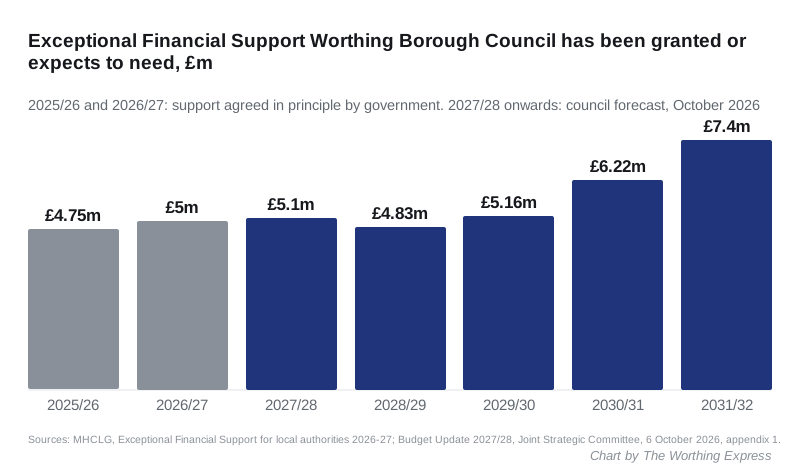
Worthing has needed EFS for two years running. The government’s own list shows support agreed in principle of £4.75 million for 2025/26 and £5 million for 2026/27. For comparison, Brighton and Hove had £15 million agreed in principle for 2026/27. (MHCLG, Exceptional Financial Support for local authorities for 2026-27)
The numbers for 2027/28
The council’s medium term financial plan, in appendix 1 of the report, sets out the gap:
| Worthing Borough Council, 2027/28 | £ |
|---|---|
| Spending needed before government funding | £25.60m |
| Income from council tax, business rates and grants | £20.96m |
| Gap to fill | £4.64m |
| Interest on the EFS borrowing | £0.46m |
| EFS needed | £5.10m |
The forecast for later years is lower than it was in July. The council now expects to need £7.4 million in 2031/32, down from £10.08 million. But the need does not disappear in any year of the plan.
The report gives several reasons the 2027/28 figure has gone up:
- the cost of financing the council’s borrowing rises by £1.8 million in 2027/28, because of the capital programme, interest rates higher than assumed and debts that need refinancing
- forecast income from investments has fallen, hit by lower interest rates and by smaller expected proceeds from selling council assets
- the cost of the Worthing Integrated Care Centre and other long-term commitments is built in from 2027/28
Homelessness is the biggest pressure
This year’s budget added £2 million to Worthing’s homelessness spending. The report says the service is still forecast to overspend by £1.5 million.
It calls this “a major factor” behind the expectation that Worthing “will continue to require support through the EFS scheme for the foreseeable future”. That will hold, it says, unless demand falls or the government funds homelessness differently.
The report also points to a high number of supported accommodation placements in the area. These have “increased exponentially over the last 3 years”, partly because of decisions by other bodies about where to place people. Officers have raised it with the housing ministry and the Department for Work and Pensions. The report says there is “no indication that any targeted funding will be provided”.
The councils are reviewing who qualifies for social housing to help bring the overspend down. That consultation is open until 20 October. We reported the details here.
What the government’s review found
The government’s offer of EFS came with a condition: an outside review of the council’s finances and governance. It was published in August. (MHCLG, Worthing Borough Council: external assurance review, 2026-27)
The budget update quotes it. The reviewers said “the council has taken appropriate and comprehensive action within its control to manage its position”. They found “capability is strong, but capacity and pace remain the key limiting factors”.
They also warned that further cuts “would fall disproportionately on core and statutory services, including housing and regulatory functions”. Their conclusion was that “it is likely that it will continue to require EFS in future years”.
What it means for you
- Council tax. The plan assumes Worthing’s share of council tax rises by 2.99% a year. The real ceiling is the referendum limit, which the government confirms later in the year. The report notes the government expects councils on EFS to raise council tax by the maximum. The final figure is set in February. Our Worthing council tax bands page has this year’s charges.
- Fees and charges. The plan assumes a 2.5% rise across council fees in 2027/28, including things like parking and beach huts, while those charges are reviewed.
- Reserves are thin. Worthing held £1.98 million in its general working balance on 31 March, 8% of its net budget. All its revenue reserves together came to £4.98 million, less than one year’s EFS.
- Nothing is decided tonight. This is a progress report. The next budget update goes to the committee in December, and the full council sets the 2027/28 budget early next year.
Adur’s position is different. Its plan shows a balanced 2027/28 budget, with a gap of £800,000 opening in 2028/29.
Sources
- Budget Update 2027/28, report by the Corporate Director for Resources, Joint Strategic Committee, 6 October 2026, including appendix 1
- Joint Strategic Committee agenda, 6 October 2026, Adur & Worthing Councils
- Exceptional Financial Support for local authorities for 2026-27, Ministry of Housing, Communities and Local Government
- Worthing Borough Council: external assurance review, 2026-27, Ministry of Housing, Communities and Local Government
Have your say